How Multi-Agent AI Systems Are Changing the Way Software Gets Built
A technical look at how specialized AI agents divide software development work, and where the approach still breaks down.
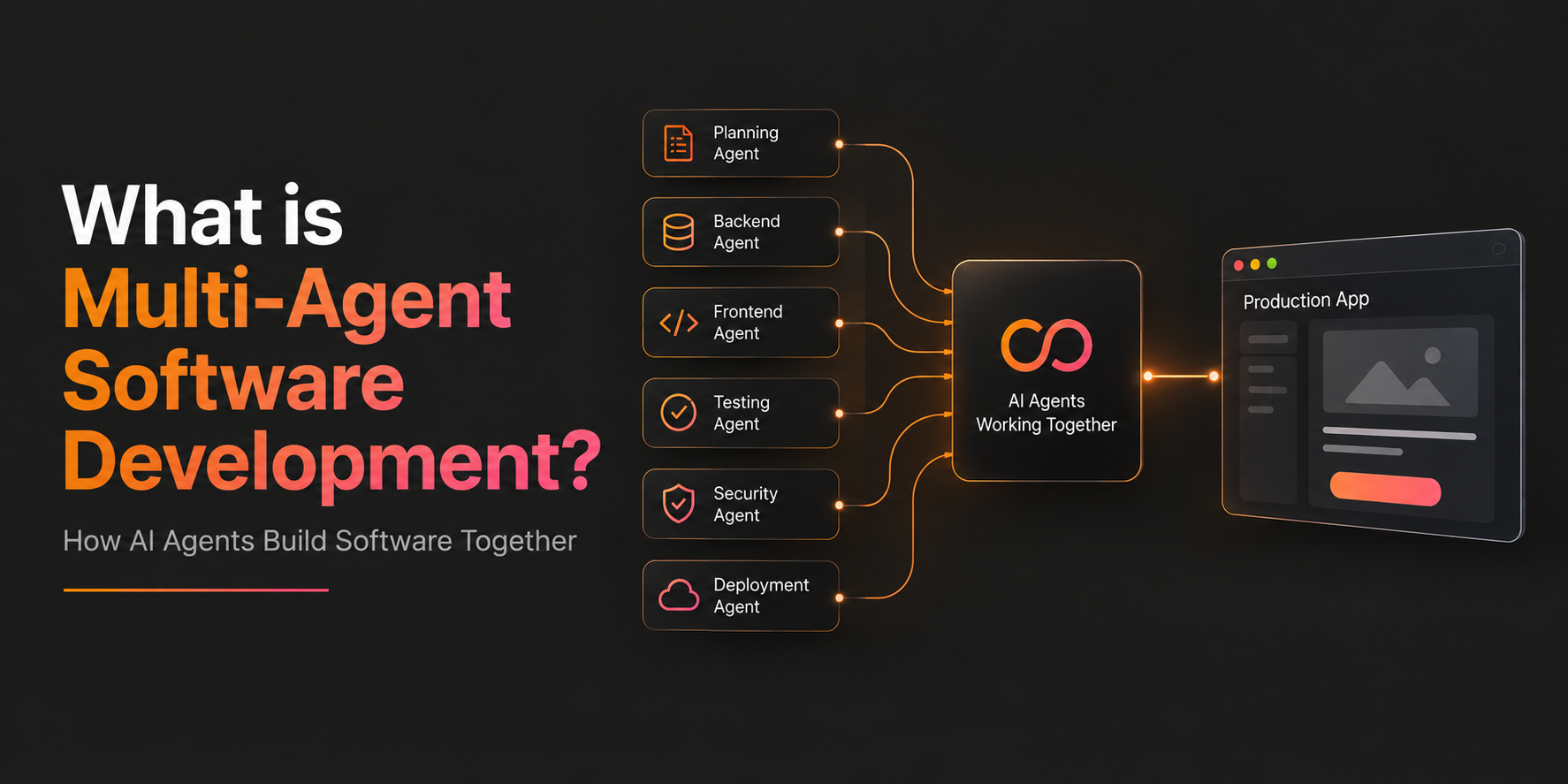
Ask a developer who's spent real time with AI coding tools what changed in the last year, and the answer is rarely "the model got smarter." It's closer to "I stopped asking one agent to do everything." That shift from a single AI agent handling an entire project to several specialized agents dividing the work is what's usually meant by multi-agent software development, and it's worth understanding on its own terms rather than as a marketing label.
What multi-agent software development actually means
Multi-agent software development is an approach where multiple AI agents, each responsible for a narrower slice of the work, collaborate to plan, build, test, and deploy an application. A planning agent turns a goal into requirements. An architecture agent defines the data model and service boundaries. A frontend agent builds interfaces. A backend agent implements the API layer. A testing agent validates the result against the original requirements. The agents share context, the same requirements document, the same codebase, the same test output rather than working from isolated conversations, and a workflow coordinates how work moves between them.
The core mechanics are consistent across most implementations:
Specialized roles — each agent handles one kind of work, rather than one generalist agent handling all of it.
Shared context — every agent works from the same source of truth.
A defined workflow — planning, execution, review, and deployment happen in a repeatable sequence.
Human oversight — requirements, review, and deployment approval stay with a person.
Why single-agent workflows hit a ceiling
Single-agent tools remain the right choice for a large share of day-to-day coding: autocompletion, a scoped refactor, a unit test for one function, explaining an unfamiliar regex. The failure mode shows up on larger, multi-layer work, a project with a database schema, an API layer, a frontend, and interdependent features. Past a certain size, a single agent starts exhibiting a specific, recognizable problem: a component several files in stops matching a convention set earlier in the same session, or a change to a data model doesn't propagate to the API layer that depends on it.
A Google Research study on agent scaling put a number on when splitting the work actually helps: multi-agent coordination delivered an 81% improvement on tasks that were genuinely parallelizable, but caused up to 70% degradation when applied to tasks that were fundamentally sequential. That's an important qualifier for anyone evaluating whether to adopt a multi-agent workflow, the gain isn't automatic. It shows up specifically when the underlying work can actually be split into independent pieces, which a meaningful share of full-stack development can, once the architecture is defined up front.
In practice, this means the case for multi-agent development is strongest for projects with clear separable layers, and weakest for tightly sequential work where each step depends entirely on the last, a data migration with strict ordering, for instance, or a tightly coupled algorithm that can't be meaningfully parallelized.
The roles that show up repeatedly
Most multi-agent systems, whether assembled from an open framework or built into a product, converge on a similar set of roles:
Product/planning agent — converts a goal into requirements and acceptance criteria.
Architecture agent — defines system structure, data models, and service boundaries.
Frontend agent — builds interfaces and client-side behavior.
Backend agent — implements APIs and business logic.
Database agent — designs schemas and migrations.
QA agent — writes and runs tests against the acceptance criteria.
Security agent — reviews permissions, secrets, dependencies, and attack surfaces.
DevOps agent — handles environments, deployment, and observability.
Review agent — checks the combined output against requirements before anything ships.
Few teams start with all nine. A common starting point is three or four roles, planning, frontend, backend, and QA with more added as the project's scope grows.
How coordination actually works
The coordination loop tends to follow a consistent pattern:
Shared context — all agents access the same requirements, codebase, and prior decisions.
Task decomposition — a planning or coordinator agent breaks the goal into discrete, assignable tasks.
Parallel execution — independent tasks run at the same time rather than sequentially.
Handoffs — agents pass along dependencies: an API contract, a finished data model, a completed interface.
Conflict detection — the system flags contradictory or duplicate changes before they compound.
Review — a review step checks the combined output against the original requirements.
Deployment and feedback — the result deploys to a preview or production environment, and the next iteration starts from there.
A few orchestration patterns recur across implementations: a coordinator pattern, where one agent plans and assigns tasks to others; a pipeline pattern, where work moves through fixed stages in order; a swarm pattern, where many agents work on small tasks in parallel under a central coordinator; and a human-in-the-loop pattern, where a person approves high-impact changes before they proceed. Open frameworks like LangGraph and CrewAI expose these patterns directly for developers to configure. Build platforms, Replit, Lovable, and 8080.ai among them, apply a version of the same role separation with more guardrails built in by default, typically pairing it with an approval step before generated code reaches production.
What actually improves, and what doesn't
The benefits that hold up under scrutiny are structural, not just about raw speed: reduced context load on any individual agent, more consistent conventions within a given domain because a specialized agent applies them repeatedly, and testing built into the workflow rather than added afterward. Parallel execution does compress timelines on separable work, but that's a consequence of the structure, not the main justification for adopting it.
The risks are just as real and worth stating plainly. Coordination overhead is a genuine cost, agents can duplicate work or make contradictory decisions if their shared context isn't kept current. Access-scoped security matters more as more agents touch a codebase, since each additional agent is another surface with some level of access to secrets, data, or infrastructure. And there's a risk that's easy to underweight: more automated output doesn't reduce the review burden by default. Google's 2025 DORA Report found that increased AI adoption in software teams correlated with a 9% rise in bug rates, a 91% increase in code review time, and a 154% increase in average pull request size. Multi-agent systems that generate more code across more parallel streams can amplify that pattern if review isn't scaled alongside generation.
The mitigations that show up consistently in how teams handle this: clear, written requirements before any agent starts work; a defined approval gate before anything reaches production; and regular architecture review as a project's scope expands. Some platforms build this in structurally rather than leaving it to convention, 8080.ai, for instance, generates a system requirements document before any code is written and routes every subsequent change through a diff that a person has to accept or reject. That kind of default doesn't eliminate the review burden the DORA data points to, but it does put a checkpoint in the path by design rather than relying on a team to remember to add one.
A worked example
Consider a team adding a user profile feature: a profile page, account settings, avatar upload, and the supporting API endpoints. In a multi-agent workflow, a planning agent defines requirements and acceptance criteria first. An architecture agent proposes the data model and API shape. Frontend and backend agents build their respective pieces in parallel against the same API contract. A database agent handles the schema and migration. A QA agent writes and runs tests across the feature. A security agent reviews the upload path and access controls specifically, since file uploads are a common point of failure. A review step checks the combined work against the original requirements before a human approves deployment to a preview environment, and only then to production.
Nothing in that sequence is unfamiliar, it mirrors how a human team would typically structure the same feature. The difference is that steps that don't depend on each other run concurrently, and the handoffs between agents are explicit artifacts (a schema, a contract, a test result) rather than something held in one person's memory across a long working session.
Adopting this without overcommitting
A smaller pilot beats a full rebuild for a team evaluating this for the first time:
Choose a well-scoped project — a single feature or internal tool, not the whole product.
Write clear requirements and a definition of "done" before any agent starts.
Start with two or three roles — frontend, backend, and QA is a common combination.
Set up an approval step before any output reaches production.
Measure the outcome — time spent, defect rate, amount of rework before adding more roles or expanding to additional projects.
Whether a team assembles this from open frameworks or adopts a platform that has the role separation and approval gates built in already tends to come down to how much orchestration work the team wants to own directly versus inherit as a default. Neither choice removes the need for clear requirements or careful review, the roles and gates only help if someone is actually using them.
Multi-agent software development doesn't remove engineering judgment from the process. It redistributes the mechanical parts of building software across specialized agents so that judgment gets applied at the points that matter most: what gets built, and whether what shipped actually matches what was asked for.