Why Your Team Might Need Two Different AI Tools to Ship a Production App
AI coding tools are splitting into two categories and knowing which one you need saves months.
Most teams evaluating AI coding tools start with the wrong comparison. They line up feature lists which one writes cleaner code, which one is faster, which one has the better autocomplete as if every AI coding tool is competing for the same job. Increasingly, they aren't. The market has split into two distinct categories, and mixing them up when you're choosing a tool is a slower mistake to notice than it sounds, because both categories will happily generate code for you. They just generate it at a different point in the process, for a different reason.
Understanding that split matters more this year than it did last year, because the gap between "AI writes code fast" and "AI helps ship a production application" has become the actual story in software delivery.
What's actually driving the split
For a while, most AI coding tools looked interchangeable: type a prompt, get code back, differentiate on speed and quality. That framing is breaking down, and there's a specific reason why.
According to CloudBees' 2026 State of Code Abundance Report, AI now generates or assists in writing 61% of the average enterprise codebase. At the same time, 81% of enterprise technology leaders report an increase in production issues tied to that AI-generated code. Those two numbers together describe the actual problem: generating code was never the hard part of shipping software. Deciding what to build, keeping an architecture coherent as requirements change, and getting something safely into production always were the hard parts. Tools that only accelerate code generation don't touch any of that, they just get teams to the hard part faster, which is exactly why the hard part is now showing up as a headline statistic instead of staying quietly hidden behind slower development cycles.
That pressure is what's splitting the category. One group of tools optimizes the "write and edit code" layer. A newer group is trying to own the layer above it turning a product idea into requirements, architecture, and a deployable application before a human has to manually assemble the pieces.
Category one: the AI-native code editor
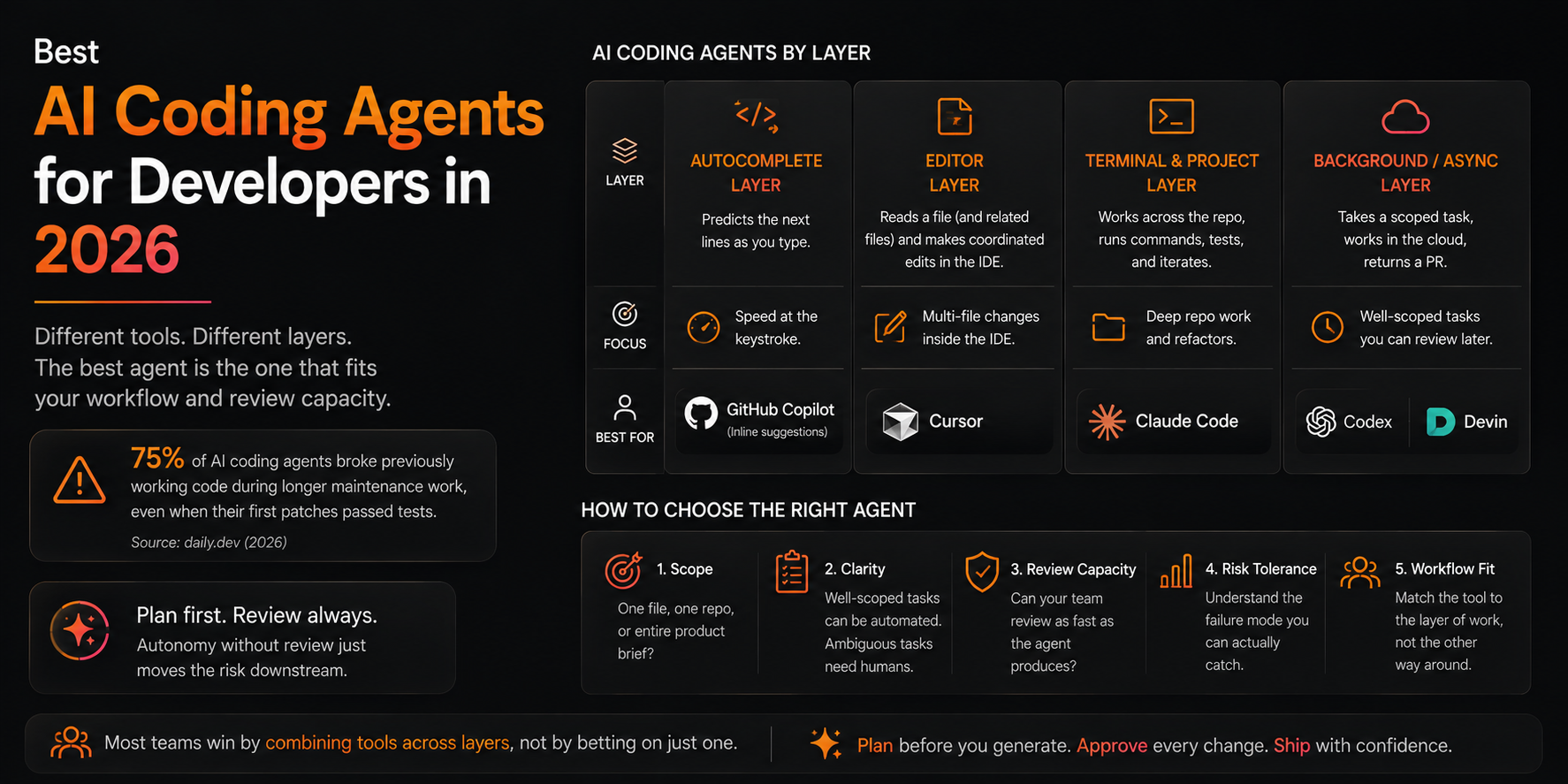
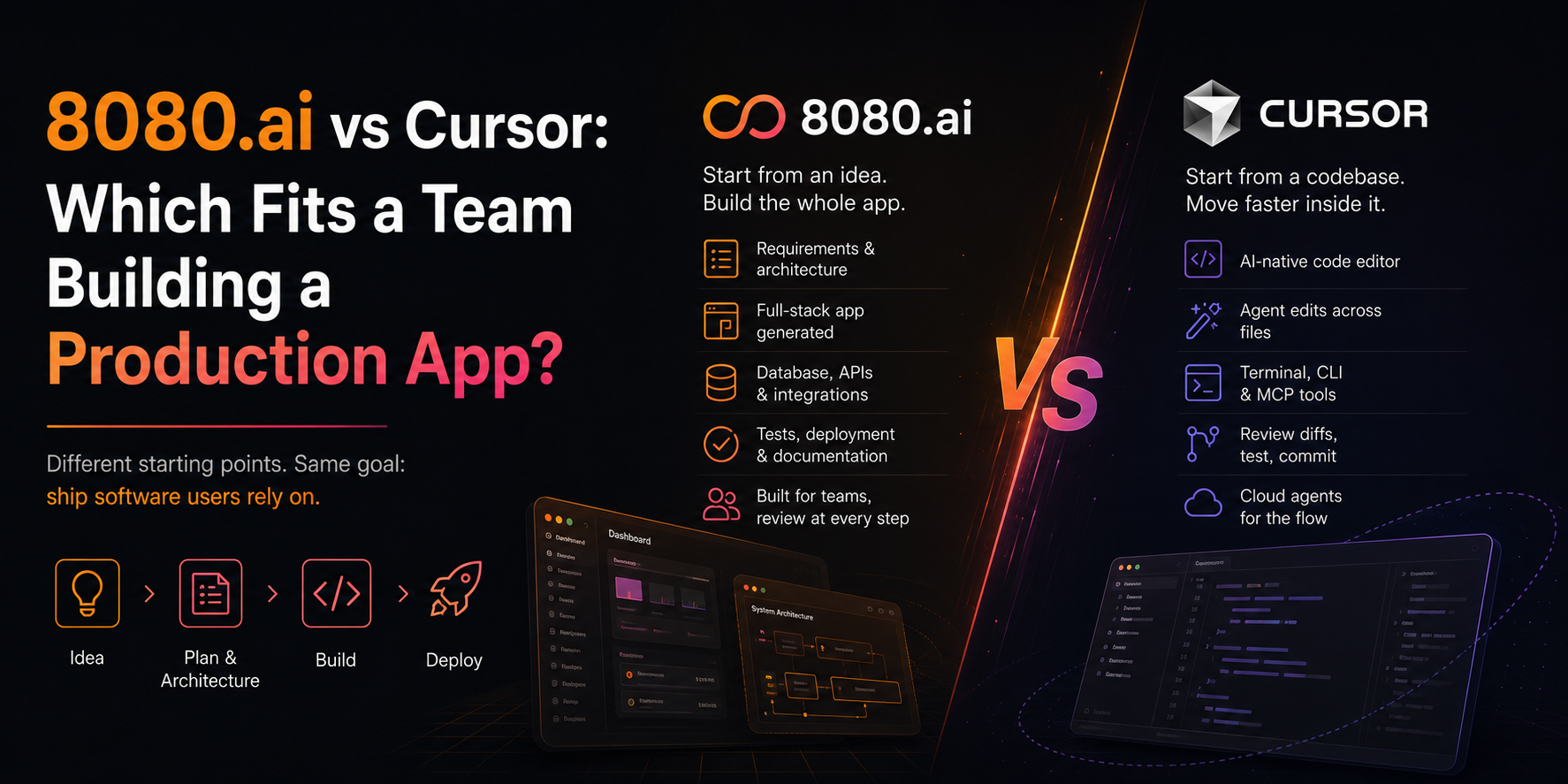
The first category is built around an existing codebase. You open a repository, ask the AI questions about it, apply agent-driven edits across multiple files, review the diff, run tests, and commit. These tools assume the architecture, the data model, and most of the team's technical decisions are already settled their job is to make working inside those decisions faster, not to make the decisions themselves.
This is a legitimately large and valuable category. Most day-to-day engineering work adding a feature to something that already exists, fixing a bug, refactoring a module falls squarely into "we have a codebase and need to move faster inside it." An editor-centric AI tool is built exactly for that loop, and there's no reason to look past it for that kind of work.
Where this category runs out of runway is earlier in the process: before there's a repository at all, before anyone has decided on an architecture, when the actual bottleneck is coordinating product, design, and engineering decisions rather than typing code.
Category two: the AI build platform
The second category starts further back from a natural-language product description rather than a repository. Platforms in this category, including 8080.ai, work through requirements, system architecture, and user flows before generating an implementation, producing a documented specification and diagrams that a human reviews and approves at each stage instead of receiving a finished application with no visibility into how it got there.
8080.ai's own product pages describe this as a coordinated process that produces a working frontend, backend, database layer, test coverage, and deployment configuration together, rather than as separate steps a team has to stitch together afterward. That's a different job than editing an existing repo, it's closer to the planning and architecture phase that, on a traditional team, would involve a tech lead and a product manager working through decisions on a whiteboard before anyone touched an editor.
Other tools compete in this same general space with different tradeoffs, some lean more toward rapid prototyping, others more toward infrastructure and deployment. The category, not any single product in it, is the thing worth understanding.
How to tell which category your team actually needs
The honest answer is that most teams need both, just not at the same time.
If your team already has a codebase, an architecture someone signed off on, and the work in front of you is adding a feature, fixing a bug, or refactoring something, you're squarely in editor territory, and reaching for a build platform there would mean adopting an unfamiliar workflow to solve a problem you don't have.
If your team is starting from a product brief or an idea, with the architecture, data model, and how several features connect to each other still undecided, a platform-first approach tends to close more of the actual gap, because the bottleneck isn't how fast anyone can type. It's coordinating decisions that haven't been made yet.
Neither category removes the need for a human to review security, approve the architecture, or own the release decision. What's changed is which part of the work AI is being asked to help with, and being clear about that before you pick a tool saves a lot of the mid-project tool-switching that's become common enough to have its own pattern.
A scenario that makes the split concrete
Imagine a small team building a multi-tenant analytics dashboard, authentication, workspace permissions, billing, data visualization, and an admin panel. If none of it exists yet and the requirements are still moving, a platform-first approach helps get a coordinated first version of the whole system in place, with the frontend, backend, and infrastructure planned together instead of separately.
Once that foundation exists, the nature of the work changes. Someone needs to add a billing edge case, debug a permissions issue, or refactor how the frontend talks to the API, narrower, file-level tasks where an editor-centric tool is the more natural fit. In practice, a lot of teams end up moving through both categories at different points in the same project, rather than committing to one for the life of the product.
The question worth asking instead
"Which AI coding tool is best" is a hard question to answer honestly, because it depends entirely on what your team is actually stuck on. A more useful question is whether the bottleneck right now is writing and modifying code your team already understands, or coordinating the work it takes to turn an idea into something that can ship. Those are two different problems, they're being solved by two different categories of tools, and most teams building a production application will eventually need an answer to both not because either category is incomplete, but because software delivery has always had two distinct phases, and it's only recently that AI tools have started specializing by phase instead of trying to do all of it at once.