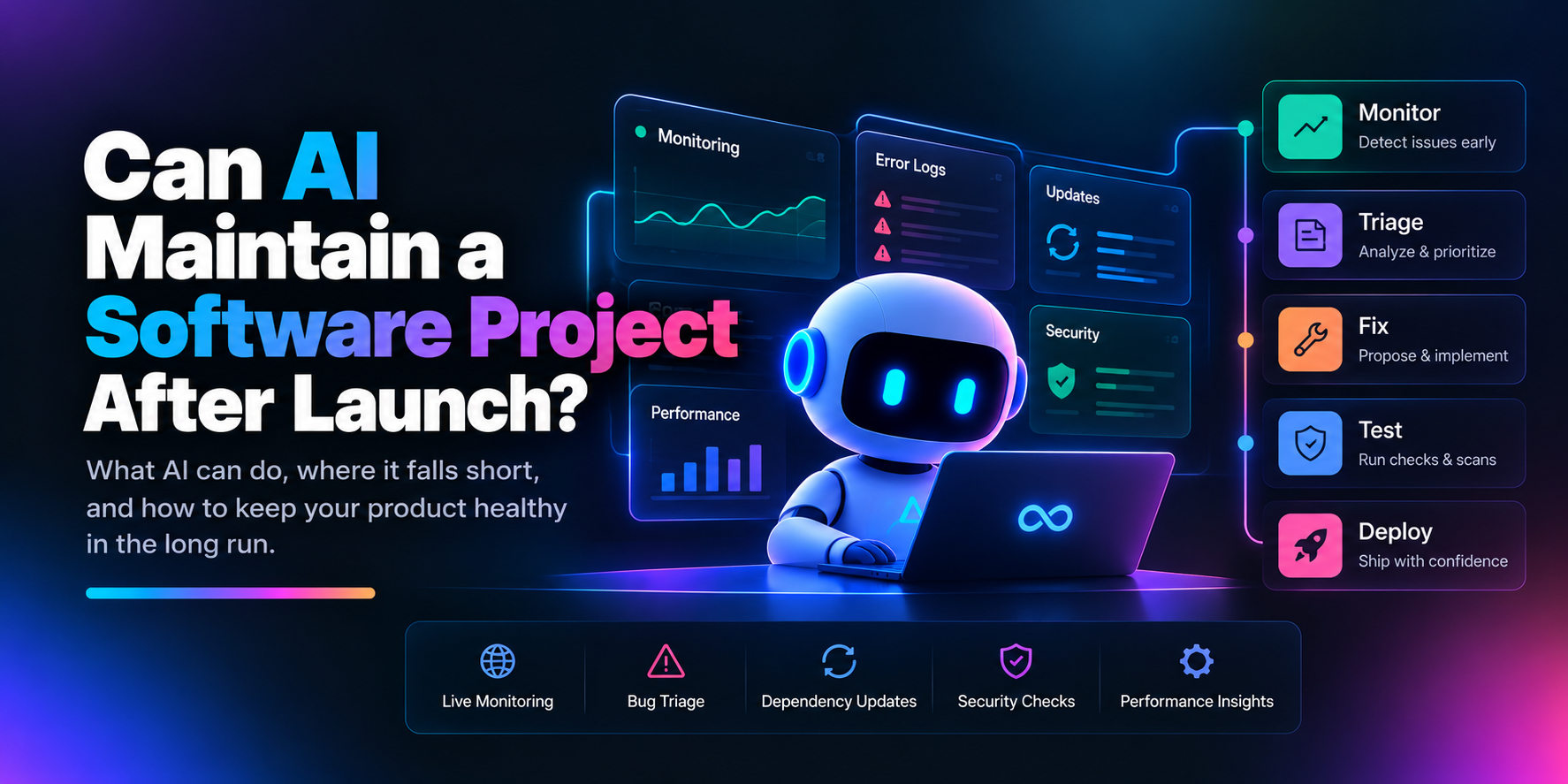
Can AI maintain a software project after launch? In practice, yes for a lot of the routine work: watching production, grouping errors, preparing dependency updates, and drafting patches. No for the parts that need accountability: architecture, security and compliance, release approval, and cross-layer debugging. The interesting engineering question is not whether AI can do the work, but how you structure a codebase and a review process so that a person can still make good decisions about what AI produces.
What changes the day a product goes live?
Before launch, the test is simple: does it work? After launch, the test becomes: can we change it safely?
Three things shift at once. Real users find paths the happy-path demo never touched. Dependencies, runtimes, and third-party APIs start drifting. And the first serious bug sends someone into a file that no human wrote.
A useful mental model is three jobs running in parallel: keep the system running, keep it current, and keep it understood. Most teams staff the first, half-staff the second, and forget the third. With hand-written code, the third job happens as a side effect, because understanding accumulates while people write. With generated code, it does not. That gap is the real maintenance risk, and it is invisible on any dashboard.
Which maintenance tasks suit AI best?
The tasks that suit AI are the ones that are repetitive, pattern-based, and easy to verify.
For monitoring, an AI layer on top of metrics and logs can flag drift that fixed thresholds miss: a slow rise in p95 latency, an error rate that breaks the usual weekly pattern, or a cost curve that starts to bend. The practical setup is still one dashboard and one alert channel that a named person reads. A small setup someone actually watches beats a sprawling one everyone ignores.
For triage, AI can read stack traces and logs, cluster duplicate reports, and propose a probable cause. Treat that as a hypothesis to test, not a diagnosis. The useful habit is to have the assistant cite the specific log lines or code paths behind its hypothesis so a reviewer can check it in a minute rather than trust it.
For dependencies, the pattern that works is automated update proposals, each as its own small pull request, gated by tests and vulnerability checks, and merged by a person. Generated code sometimes pulls in packages nobody chose on purpose, so it is worth reviewing the dependency list itself instead of assuming you know what is in it.
For feedback and support, AI is good at turning a pile of tickets into a short list of recurring issues, which is often where the next sensible piece of work comes from.
Every one of these ends with a person making a decision. That is not a limitation to engineer away. It is the design.
Where does AI-assisted maintenance break down?
It breaks down where the answer depends on context the model does not have, or where someone has to be answerable.
Architecture decisions compound. Choices about data ownership, service boundaries, and failure modes shape every later change, and the trade-offs belong to the team that will live with them. Security and compliance need accountable owners because regulations shift and incidents have consequences. Production releases carry a large blast radius, so the final approval should be human. Bugs that span several layers (a queue, a cache, a schema change, and a client assumption interacting) need judgment about what matters, not just pattern matching.
There is also early evidence that AI-authored code accumulates quiet debt. A 2026 empirical study tracked issues from 302.6k AI-authored commits across 6,299 GitHub repositories, running static analysis before and after each change. It found 22.7% of the issues those commits introduced still present in the latest repository version, with code smells making up 89.3% of all issues. The authors note that AI-generated code can introduce long-term maintenance costs and calls for stronger quality assurance.
The caveats matter: it covers public repositories and relies on static analysis, so read it as a directional signal. The engineering takeaway holds either way. Merged does not mean finished, and review needs to continue after the merge.
Why are teams choosing tools that put structure before code?
The shift here is less about technology than about trust.
Early AI coding tools earned attention through speed. After a few releases, the concern changes: if this breaks next quarter, can someone explain how it fits together? That concern pushes teams to value a different set of outputs. A written statement of what the product should do. A diagram of how it is structured. A clear record of what changed and why. All of these are what a maintainer needs on a bad night.
It also changes the job. When most code is generated, an engineer's time moves from writing toward reviewing, and reviewing only works if there is a source of truth to review against.
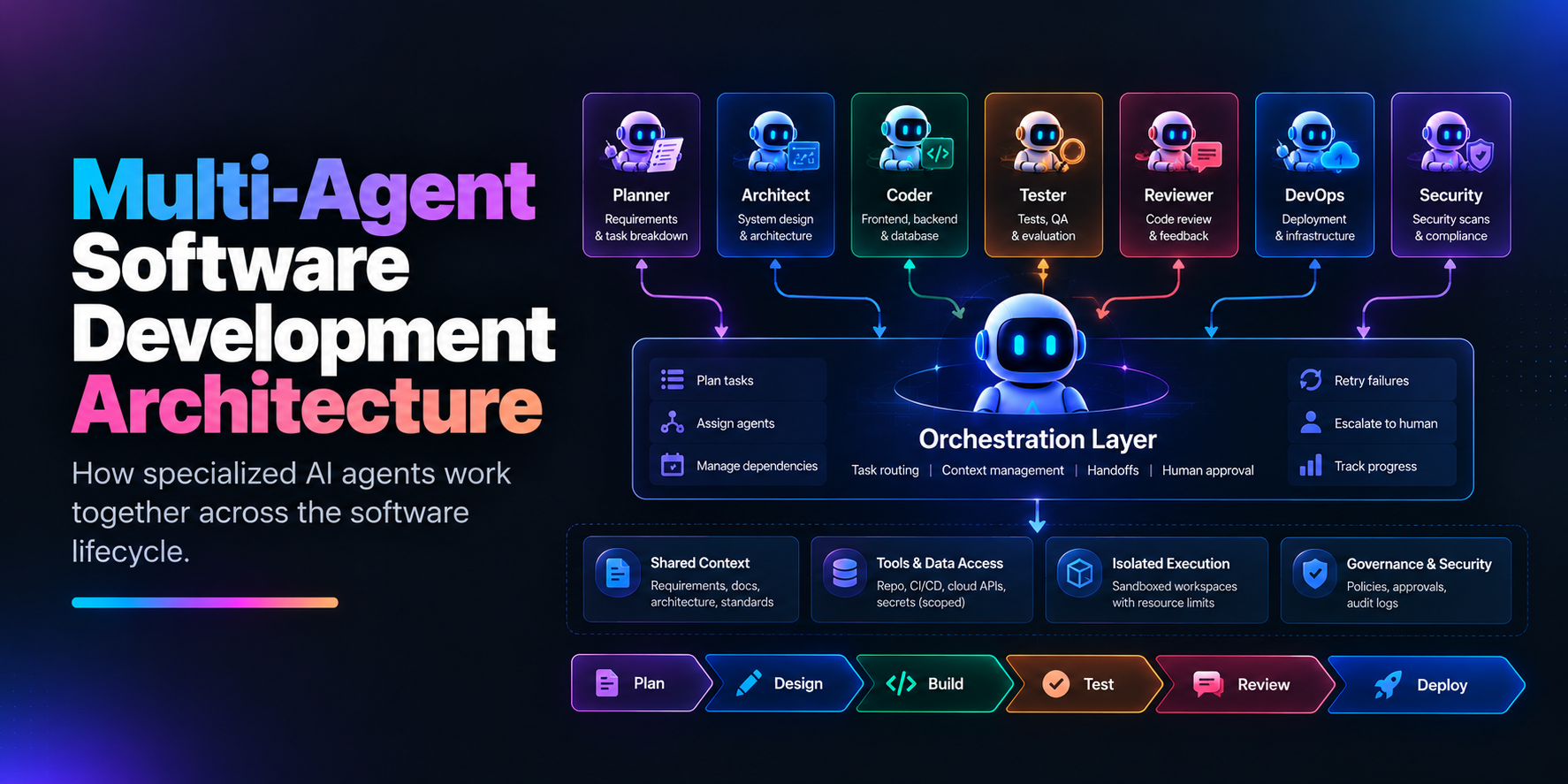
This is the reasoning behind architecture-first platforms such as 8080.ai, an agentic coding platform that builds software with coordinated AI agents. As described in its own maintenance write-up, the process starts from a requirements document that later work derives from, with changes arriving as diffs a person accepts or rejects, and five architecture diagrams drafted before any code is generated. The same write-up says that on 8080.ai each task runs in its own isolated workspace, merges by pull request, and is scanned for leaked secrets, vulnerable dependencies, and unprotected API routes before it reaches staging. Whether or not a team uses a platform like this, the pattern is portable: make the artifacts a maintainer needs at month six a byproduct of building.
How should you structure a maintenance workflow?
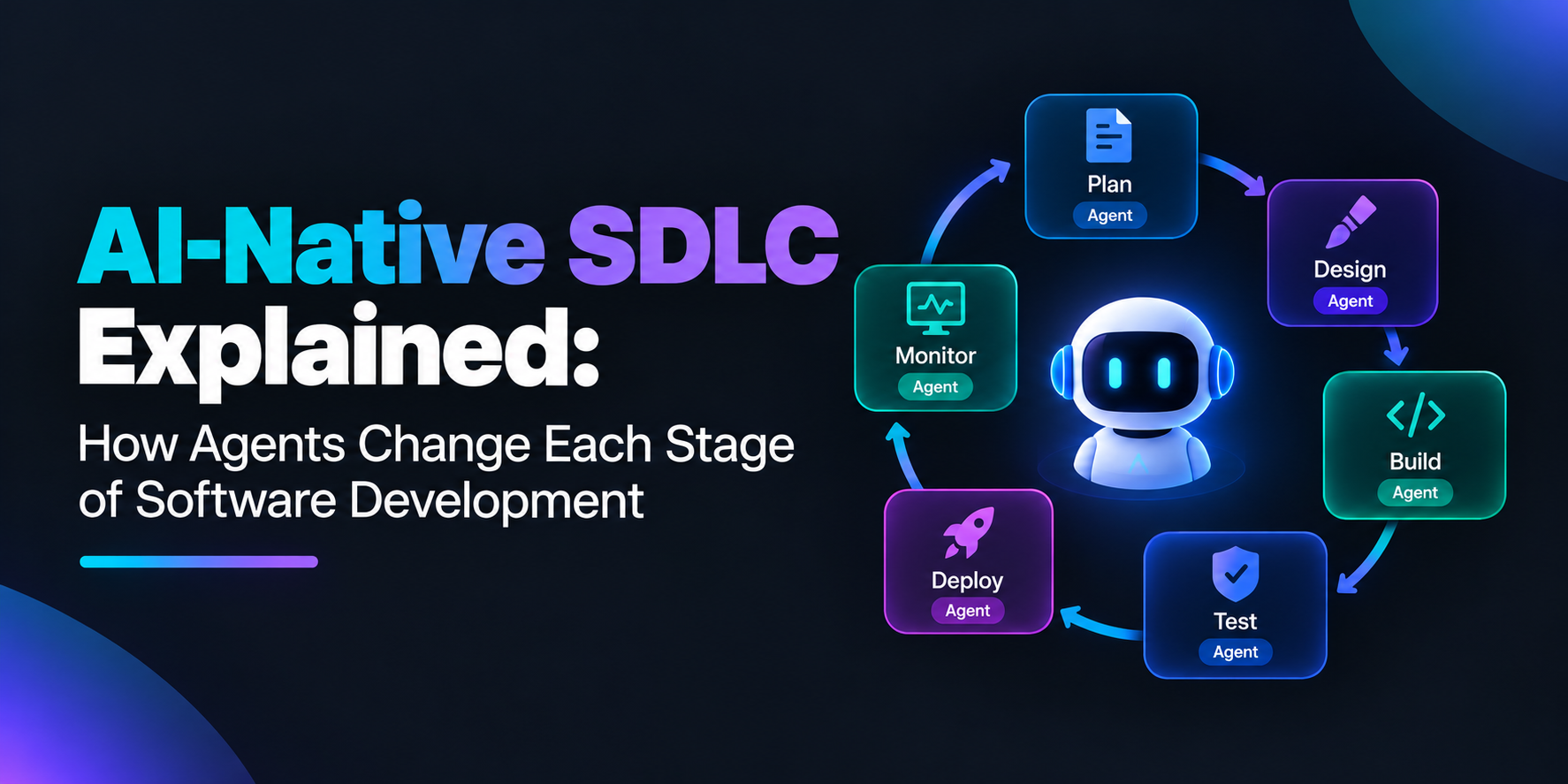
Start with a loop. Monitor, detect an anomaly, let AI triage it, have a person review the proposed fix, patch, run tests, deploy, and return to monitoring. Then attach a cadence so the loop does not decay.
Weekly: triage tickets and user feedback, read a manual sample of any AI-generated outputs, and choose the maintenance tasks for the next sprint. Monthly: apply dependency updates, rotate secrets and credentials, and review upcoming API deprecations in your integrations. Quarterly: do a debt review, run a scaling check, and confirm that documentation still matches reality. Immediately: apply critical security patches.
Two engineering habits make this safer with generated code. Keep changes small enough to understand, because a reviewer who cannot follow a diff is not really reviewing it. And pin existing behavior with tests before refactoring anything near a flow customers depend on, so a change that quietly alters behavior fails loudly in CI.
A small debt register helps too. A plain text file in the repo is enough, as long as every item has a location, a risk, and a named owner. Then schedule small refactoring windows against it, so the register drives work instead of collecting dust.
What does maintenance typically cost?
A long-repeated rule of thumb puts annual maintenance at roughly 15–25% of the original build cost. Treat it as a starting assumption, not a measured average: integrations, compliance requirements, and how fast the product evolves can move the real number a lot. AI probably changes what the budget buys, with more time on review and less on typing, rather than eliminating it.
What mistakes show up most often?
Treating maintenance as an afterthought is the most common. Upkeep that is not planned for does not happen, so build it into the architecture and the calendar from the start.
Over-relying on AI is the second. When a tool is usually right, reviews get thinner, and the rare miss ships. Keep humans on the decisions that are hard to undo.
Having no owner is the third. Name someone for infrastructure, application behavior, AI behavior, and security. One person can wear two hats. Nobody wearing a hat is the failure mode.
Skipping the third job is the quiet one. Keep requirements current, keep architecture diagrams honest by updating them when the shape of the system changes, and write down why decisions were made, even if it is two lines in a pull request description.
So what is the practical answer?
AI can carry a large share of the watching, sorting, and preparing in post-launch maintenance, and that makes small teams noticeably more capable. It cannot own the outcome. The teams that keep AI-built software healthy treat understanding as part of the work, put an owner on every area, and keep a person on every decision that is difficult to reverse.
If you only do one thing this week, write down the owners list. Everything else gets easier once someone is responsible.
Comments
Join the discussionThe rule that every task ends with a person making a decision is the right boundary, and it is clearer than most attempts to sort maintenance into safe and unsafe work.
Treating triage as a hypothesis that cites log lines is the detail I liked most. A summary that says the payment job is failing is easy to accept without checking. One that points to the exact lines lets the reviewer agree or disagree in a minute.
The maintainer artifacts matter just as much. A written spec, a diagram and a change record are what make AI assistance useful months after launch, because the model, like a new developer, can only reason about what has been written down. On client handovers we treat those three documents as part of the delivery, not as optional extras.
The weekly and monthly cadence is sensible. How do you decide when a clustered set of tickets becomes a project rather than maintenance?