Multi-agent software development architecture is a system design where specialized AI agents each own one stage of the development lifecycle (planning, architecture, implementation, testing, review, deployment), and a coordination layer manages context, handoffs, and human approval. The aim is not a handful of agents talking to each other. It's a workflow in which every agent has a defined responsibility and produces output that can be checked.
This post is written for developers and engineering leads who are deciding how far to take that idea. It covers the problem the design solves, why teams are drawn to it, the components it needs, how work flows through it, and the places it tends to fail.
What problem is a multi-agent design trying to fix?
Most developers meet AI coding the same way: one assistant, one long conversation, and a request that quietly bundles several jobs. "Add invoicing to the app" means gathering requirements, deciding on a data model, writing the backend, building the UI, writing tests, and judging whether the whole thing is correct. A single agent will attempt all of it in one thread.
Three failure modes follow, and they're worth naming because each maps to a design decision later on.
The first is context pressure. Requirements, half-written modules, error output, and earlier decisions all share one window. As the thread grows, early constraints get diluted, and the agent starts contradicting choices it made an hour ago.
The second is self-grading. The agent that wrote the code also reports on whether it works. Passing its own tests is not independent verification.
The third is review size. Everything arrives as one large change. A reviewer can't hold it all in their head, so review turns into skimming.
Specialization addresses each of these directly. A narrow role means a narrow context. A separate checker means the author isn't the judge. Staged output means reviewable pieces.
Does splitting work across agents actually improve results?
Sometimes, and the conditions matter. Anthropic's engineering team published a detailed account of a multi-agent research system, and reported that a lead agent coordinating parallel subagents outperformed a single agent by 90.2% on their internal research evaluation (How we built our multi-agent research system).
The same article includes two cautions that developers should read closely. Multi-agent systems used roughly 15 times more tokens than ordinary chat interactions, so the task has to be valuable enough to justify the cost. And the authors point out that most coding tasks involve fewer truly parallelizable pieces than research does.
That second point is the important one for software. It means the benefit of multiple agents doesn't come from the number of agents. It comes from how well the work has been divided before the agents start. In a codebase, units of work depend on each other through shared schemas, shared interfaces, and shared conventions. If those aren't settled first, parallelism mostly produces merge conflicts and inconsistent patterns.
Why are developers adopting this approach?
Speed is the headline reason, but a quieter one seems to explain more of the pull: legibility.
Engineering teams already organize around roles. Someone writes the requirement, someone designs the system, someone implements, someone tests, someone reviews. When agent roles mirror that structure, the system is easier to reason about. A failed build can be traced to a stage. A strange design choice can be traced to a document. Compare that with a single assistant's output, where the only available question is "why did it do that?"
There's a second, more practical shift. As more of the code is generated, the scarce resource moves from writing to verifying. Reviewing a requirements document, an architecture diagram set, and a task plan before code exists is a tractable job. Auditing several thousand generated lines afterward is not. Multi-agent pipelines let a person review decisions at each stage rather than diffs at the end, and for many teams that trade is the real reason to adopt them.
What are the core components?
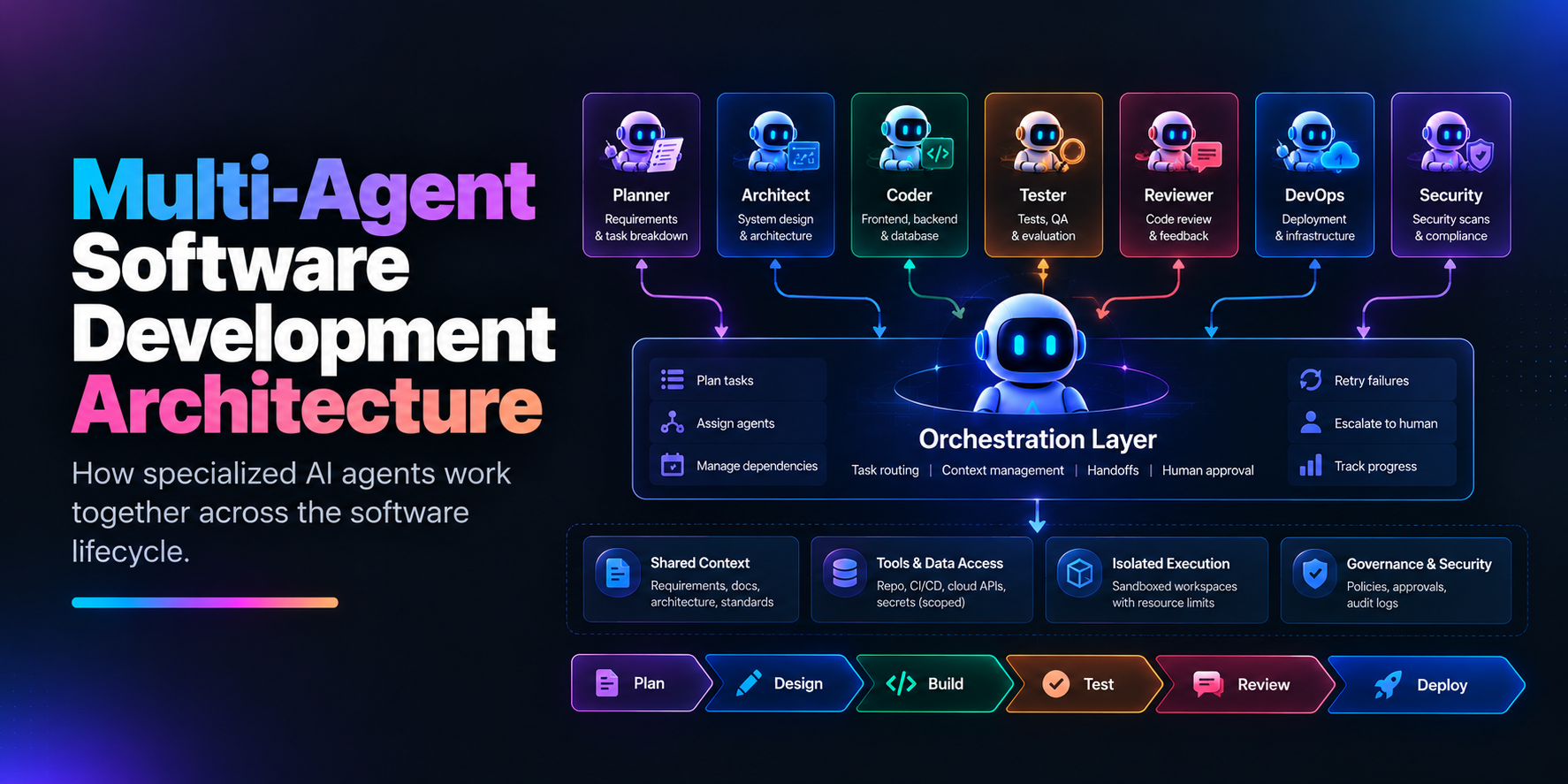
Six components show up in most designs that survive contact with production.
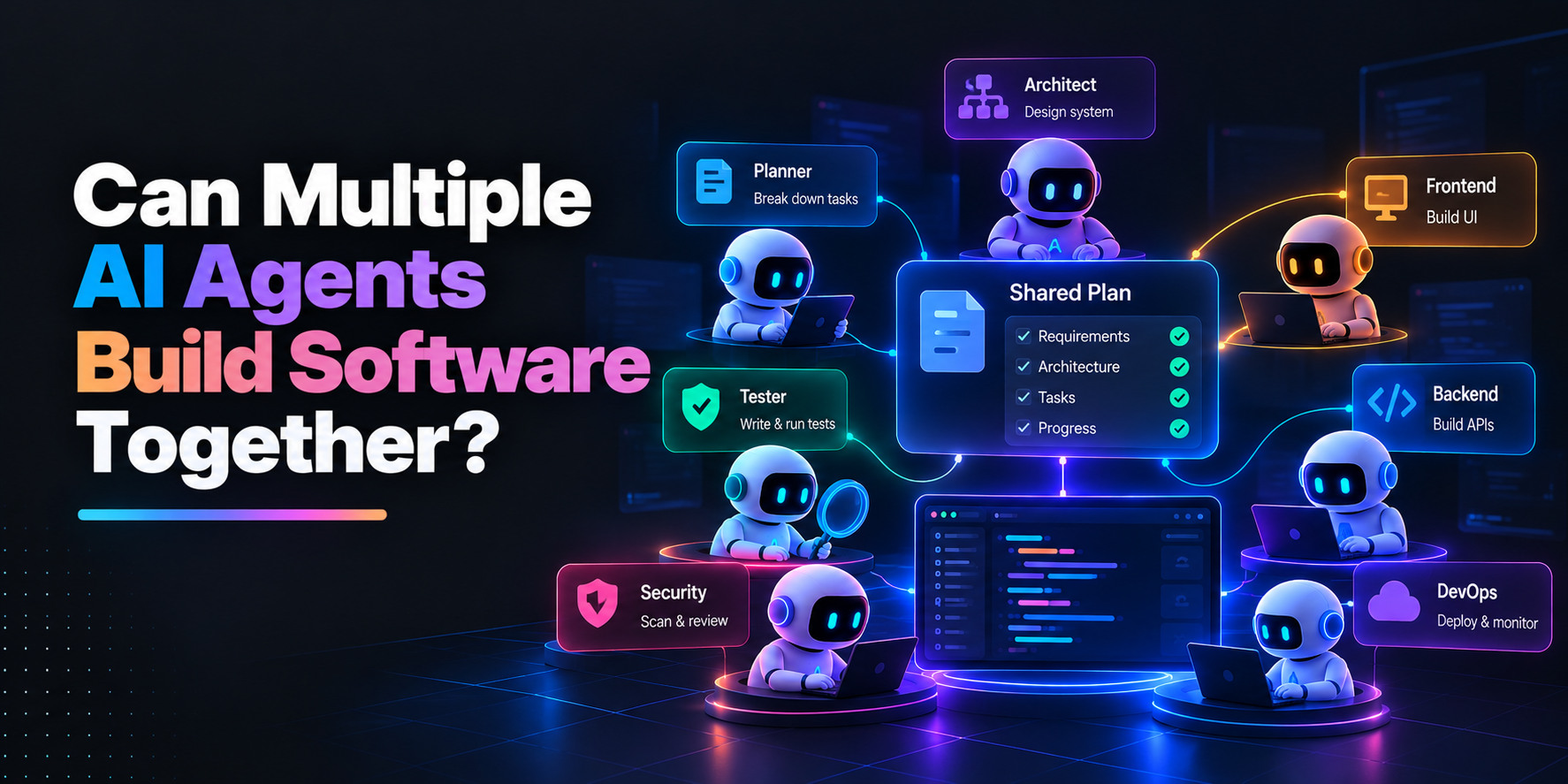
Agent roles. Common roles are planner, architect, coder, tester, reviewer, DevOps, and security. The value is in the boundaries. Each role has a clear input, a clear output, and no authority over another role's work.
Orchestration layer. This is the control plane. It decomposes a request into tasks, selects which agent takes each one, manages handoffs, retries failures, and escalates to a human when confidence is low or the stakes are high. Without it you have separate agents, not a system.
Shared context. Requirements, architecture decisions, coding standards, test data, and prior incidents live in one place that every agent reads from. Treat it as a versioned artifact. If each agent works from its own summary of what happened, details drift at every handoff.
Scoped tool and data access. Repository access, CI/CD, cloud APIs, databases, and secrets are granted per role. A tester doesn't need deploy rights. A frontend agent doesn't need production database credentials.
Isolated execution. Each task runs in an ephemeral workspace with its own dependencies, resource limits, and network controls. Mistakes stay inside the sandbox.
Governance and approval gates. People sign off on architecture, security-sensitive changes, and release. These gates move and narrow as the system matures, but they don't disappear.
What does the workflow look like end to end?
A reference shape that works well for feature development looks like this:
Request
  -> Planner          (requirements, acceptance criteria)
  -> Architect        (data model, service boundaries)
  -> Human approval   (plan and architecture)
  -> Supervisor       (task decomposition)
  -> Parallel work    (frontend, backend, tests, infra)
  -> Reviewer         (checks output against requirements)
  -> Human approval   (merge)
  -> Deployment       (staging, then production)
  -> Monitoring       (feedback into the next request)
Notice where the sequential and parallel parts sit. Everything before the supervisor is sequential because each step depends on the one before it. Parallel work only begins after a blueprint has been agreed. Everything after the parallel stage is gated again, because the reviewer and the human are looking at the combined result.
This is the ordering that protects against the failure mode described earlier. Parallel agents working from a vague plan generate inconsistent output faster. Parallel agents working from an approved blueprint generate pieces that fit.
Which orchestration patterns are worth knowing?
Four patterns cover most of what teams build.
A sequential pipeline hands work from one agent to the next. It's the simplest to debug and suits stages with strict dependencies, such as requirements to architecture.
A supervisor-worker structure puts a lead agent in charge of decomposing work and assigning it to specialists. It works well for larger builds because one component holds the overall plan.
Parallel fan-out runs several agents at once on independent tasks. It buys speed, at the price of more coordination work and a stronger need for shared conventions.
Peer-to-peer collaboration lets agents negotiate directly, for example a coder and a tester iterating until tests pass. It's flexible, and the hardest to make predictable, so it usually appears inside a stage rather than across the whole pipeline.
Most real systems combine them: sequential early, supervisor-led parallel in the middle, and tight peer loops inside individual tasks.
How much authority should agents have?
A useful way to reason about this is an autonomy ladder, where each rung grants more permissions and requires more evidence that the previous rung is working.
# Illustrative policy, not any specific product's configuration
autonomy:
  level_1_read_only:
    can: [read_context, suggest_plans, draft_code]
    cannot: [modify_production, access_secrets, deploy]
  level_2_draft:
    can: [generate_code_and_tests, open_pull_requests, propose_fixes]
    cannot: [apply_changes_directly, access_production]
  level_3_supervised:
    can: [run_approved_changes_in_sandbox, deploy_to_preview]
    requires_approval: [production_deploy, schema_changes, auth_changes]
  level_4_bounded_autonomy:
    can: [routine_remediation, scale_within_limits]
    requires_escalation: [irreversible_changes, sensitive_data_access]
Most teams should start at levels two and three and stay there for a while. Whatever the level, a few practices hold: scoped credentials with least privilege, versioned shared context, human approval on production, policy-as-code for enforcement, and continuous measurement of what the agents are doing.
What does this look like in an actual platform?
Platforms differ in where they put their weight. Some focus on orchestration primitives that teams assemble themselves. Others focus on getting a prototype running as quickly as possible. A smaller group emphasizes planning before implementation, on the reasoning that architectural mistakes are the most expensive to undo.
8080.ai belongs to that last group. By its own description, it coordinates more than ten specialized agents, including a tech lead, project manager, designer, frontend and backend engineers, and DevOps, and structures the work as a nine-step process. A system requirements agent writes a requirements document that becomes the source of truth, and later changes arrive as diffs the user accepts or rejects. A user flow planner maps screen-by-screen journeys, and the pipeline pauses until they're approved. A system architect then produces a set of architecture diagrams, and a project manager agent breaks the build into tasks and sprints. Only after the user reviews that plan does the build start.
From there, each task runs in its own isolated cloud workspace through a six-phase pipeline (setup, environment, branch, code, tests, staging) and merges by pull request. Before a task can reach staging, its workspace is scanned for leaked secrets, vulnerable dependencies, and unprotected API routes.
You don't have to use any particular tool to take something useful from that sequence. It's the reference shape in practice: requirements and architecture first, parallel implementation second, and a human gate between each stage.
Where do these systems usually break?
Four patterns account for most of the trouble.
Too many agents. Every additional agent adds coordination overhead. Anthropic's write-up describes early versions of their system spawning 50 subagents for simple queries. A better habit is to start with a minimal set of roles and add one only when an existing role is clearly overloaded.
Context loss at handoffs. Each handoff is an opportunity for a constraint to vanish. The remedy is shared, versioned context that agents read directly, rather than a chain of summaries where each agent paraphrases the last one.
Missing governance. Agents with broad standing access can make risky changes at machine speed. Approval gates, scoped permissions, and audit logs need to be in place before more than one agent can touch the codebase.
No measurement. Without traces of what each agent read, what it changed, and whether the result passed independent checks, a team can't tell whether the system is improving outcomes or just producing more output. Observability and evaluation belong in the design from the start.
How should a team get started?
Pick one workflow, such as shipping a single feature end to end, and map the smallest set of roles that covers it. Write the requirements down before any agent writes code, since agents carry ambiguity forward rather than resolving it. Decide where the human gates go before deciding how many agents to run. Then add roles one at a time, and measure each addition against what it actually changed.
The architecture is what makes multi-agent development trustworthy. Specialized agents help, but a clear plan, shared context, independent checks, and a person who signs off at the right moments are what turn a fast demo into something a team can ship. Whether that structure is assembled from components or comes from a platform like 8080.ai, the same questions apply: where does the plan live, who approves it, and what has to pass before code reaches a shared branch?
Comments
Join the discussionNo comments yet. Be the first to comment.