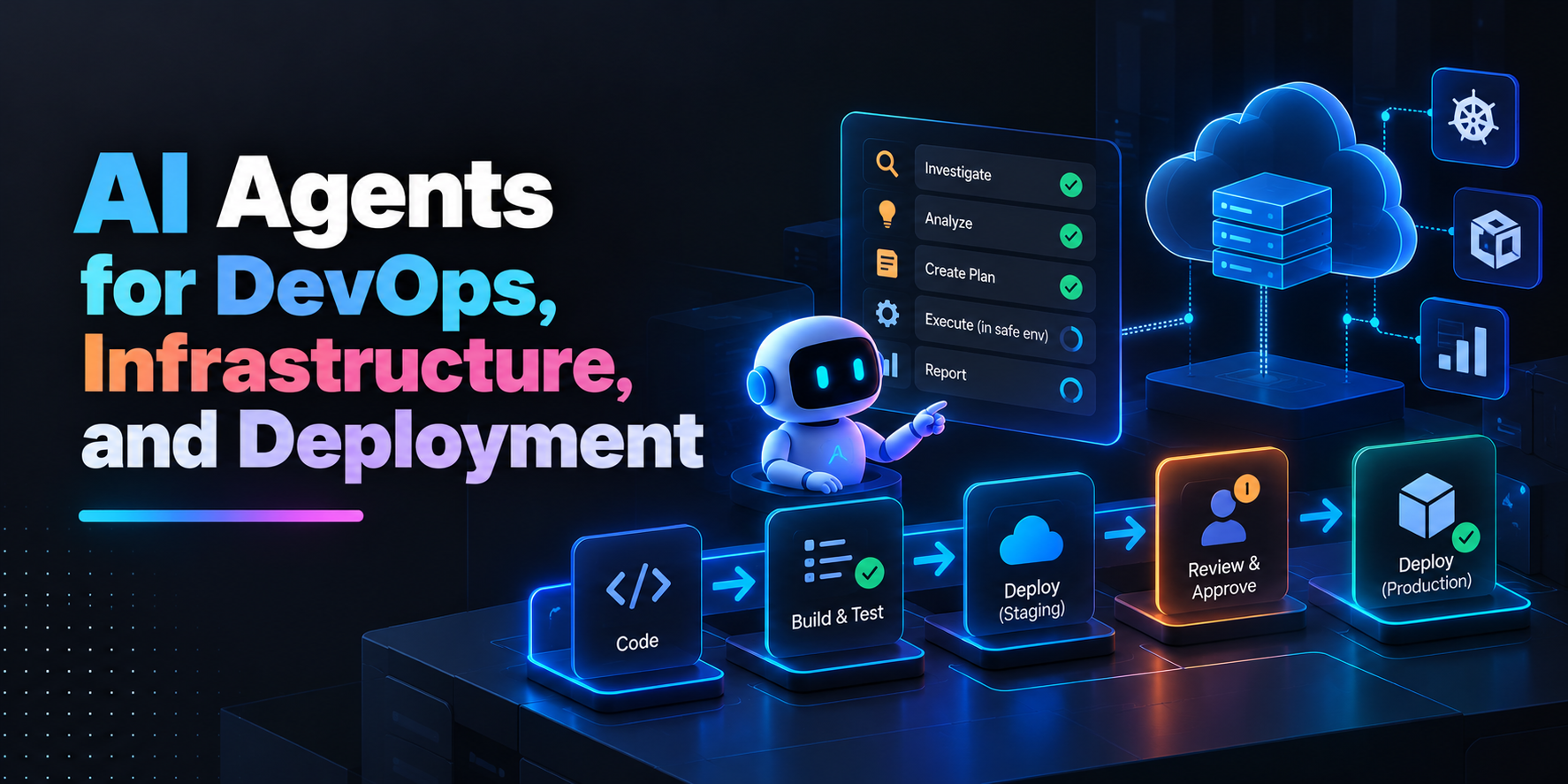
The AI Software Factory Stack: 10 Layers Around the Coding Agent
From intake to observability: what surrounds a coding agent when AI-built software has to survive review, security, and release.
A coding agent can write a working feature in minutes. What it cannot do on its own is decide whether that feature should exist, confirm it matches your architecture, prove it is safe, or explain to an auditor who approved it. Those jobs belong to the system around the agent, and that system is what people increasingly call an AI software factory stack.
This post breaks that stack into its layers, explains where teams tend to get stuck, and covers how to think about the architecture whether you assemble it yourself or adopt something that bundles parts of it.
What problem does an AI software factory stack solve?
It solves the gap between code generation and software delivery.
Generating code is the easy part now. Delivering software means the work was well defined, the agent had accurate context, the change ran somewhere safe, the tests passed, the security checks cleared, a person approved the risky parts, and the release can be reversed. When any of those steps is informal, the speed of generation just moves the bottleneck downstream, into review queues and incident channels.
A GitLab survey published in June 2026 captures the pattern. Of 1,528 developers and technology buyers surveyed, 91% reported two or more AI coding tools in active use and 54% reported three or more, while 80% said their organization adopted AI tools faster than it developed policies to govern them. The tools arrived first. The system to manage them is still catching up.
How is a software factory different from a coding agent?
A coding agent is a worker. A software factory is the workplace: it routes work to workers, gives them what they need, checks what comes out, and keeps records.
That distinction changes how you evaluate tools. Instead of asking whether an agent writes good code, you ask whether the surrounding system makes good code the likely outcome and bad code easy to catch. The first question is about a model. The second is about architecture.
What are the ten layers, and what does each one do?
Think of the stack as the path a piece of work takes from request to running software.
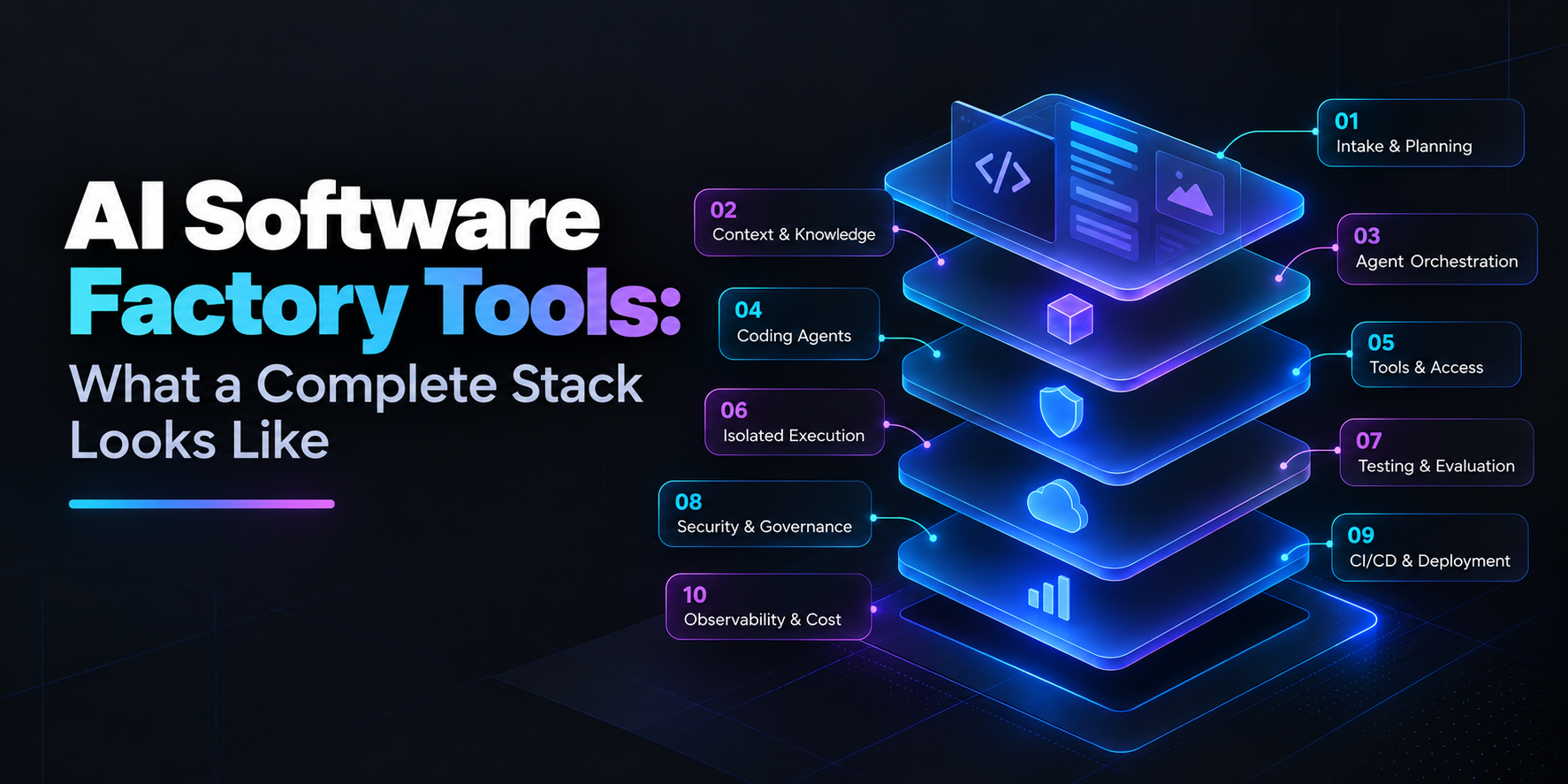
Intake and work management is the front door. Feature requests, bugs, security findings, and debt items arrive here with owners, priorities, and acceptance criteria. The quality of this layer sets a ceiling on everything after it, because agents execute what they are given. A vague ticket produces a vague change, just faster.
The context and knowledge layer supplies what the agent should know: architecture decisions, API contracts, schemas, coding standards, security policies, runbooks, and incident history. It needs search, permissions, versioning, and a way to notice stale information. Most "the agent ignored our conventions" complaints trace back to this layer, not the model.
Agent orchestration coordinates the work. It breaks tasks down, decides which agent takes which piece, passes results between them, handles retries, runs independent work in parallel, and escalates to a human at the right moment. Common patterns include sequential pipelines, supervisor-worker setups, parallel fan-out, and human-in-the-loop review.
Coding agents and specialized roles do the building. The pattern that holds up in practice is specialization: distinct roles for architecture, frontend, backend, database, QA, security, and DevOps, each working with a narrower scope. Narrower scope means less context overload and easier review.
Tool and data access connects agents to real systems such as repositories, trackers, CI, cloud APIs, and databases. This is where open protocols matter. Microsoft's multi-agent architecture guidance recommends the Model Context Protocol for secure, authenticated access to tools and data, and the Agent2Agent protocol for messaging between agents across platforms, along with least-privileged scopes for tool calls. Access should be scoped, logged, and reversible wherever possible.
Isolated execution environments keep mistakes contained. Each task gets an ephemeral workspace: clone the repository, install dependencies, run the work and its checks, then destroy the environment. Containers, Kubernetes namespaces, and microVMs all fit. The principle is that an agent should never share a blast radius with production or with another agent's work.
Testing and evaluation is how you find out whether the output is any good. Unit, integration, end-to-end, and visual tests, security scans, performance checks, and structured review all live here. A generated pull request is not evidence of quality. Passing tests, clean scans, and a reviewer's sign-off are.
Security and governance covers identity, role-based access, secret management, token scoping, policy enforcement, audit logs, and approval gates for risky actions. The guiding idea is least privilege: an agent gets the minimum access for a defined task and loses it when the task ends.
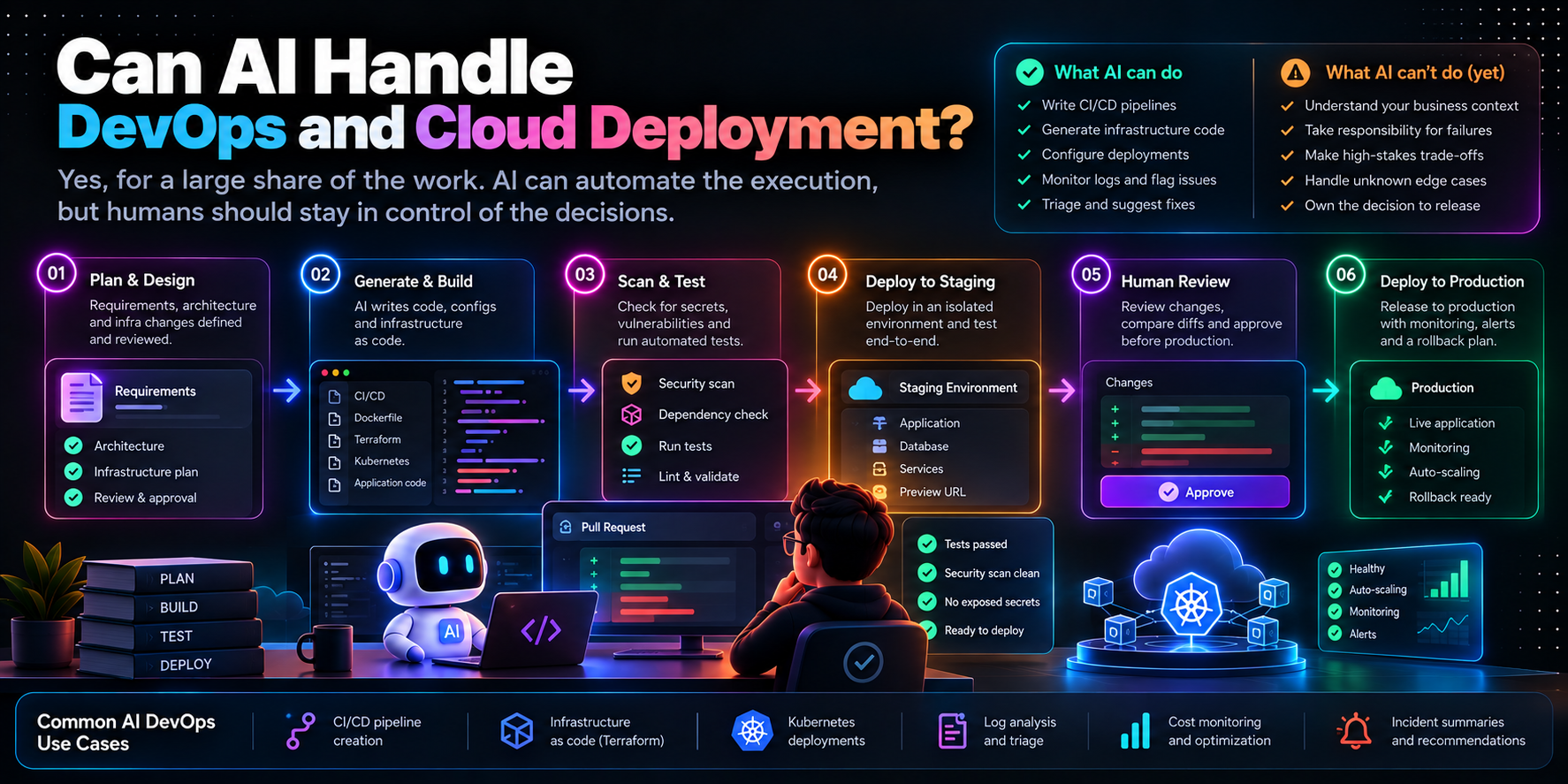
CI/CD and deployment turns approved changes into running software. Build automation, artifact management, environment promotion, rollbacks, feature flags, and infrastructure as code keep releases repeatable and reversible. AI can prepare a change. Releasing it to production should still pass through an explicit decision.
Observability and cost control closes the loop. Agent traces, tool-call logs, token usage, cost per task, success rates, and quality trends tell you whether the factory is healthy. Without it, you cannot distinguish an agent that is improving your system from one quietly adding technical debt.
Where do these stacks usually fail?
They fail at the seams between layers.
Each layer can be solid and the system can still leak. A requirement gets rewritten between intake and planning and the nuance disappears. The context layer returns last quarter's coding standard. An agent holds a broad token because narrowing it was inconvenient. Tests exist but nobody set a threshold for blocking a merge. Every one of these is a handoff problem rather than a capability problem, and handoffs are easy to leave undefined because they belong to no single tool.
The practical fix is to treat each handoff as a contract. Define what goes in, what comes out, who or what approves it, and where the evidence is stored. It is dull work, and it is what separates a stack from a collection of tools.
Why are teams moving toward integrated workflows?
Part of the answer is economics, and part of it is psychology.
On the economics side, every extra tool is another integration to maintain and another surface to secure. On the psychology side, there is a subtler change in what engineers want to spend attention on. As agents take over more of the typing, the human contribution moves toward judgment: reviewing a plan, approving a diff, deciding whether something is ready to ship. People gravitate to systems that make those decisions easy and visible, and away from systems that make them spend their day gluing outputs together.
That preference shows up in how newer platforms are designed. Instead of one agent with a text box, they put a visible process around the agents, with checkpoints where a person decides.
What does an integrated approach look like in practice?
One concrete example is 8080.ai, which describes a nine-step process from a single prompt to a running product. A requirements agent writes a document that serves as the source of truth, and later changes arrive as diffs you accept or reject. An architect agent draws architecture diagrams and a project manager agent breaks the work into tasks, then the pipeline pauses for approval. Each task runs in its own isolated cloud workspace through a staged pipeline, is scanned for leaked secrets, vulnerable dependencies, and unprotected routes, and merges by pull request. Finished work deploys to a Kubernetes namespace dedicated to the project.
Mapped to the layers above, the 8080.ai workflow touches planning and context, role-based agents, isolated execution, a security gate, and deployment, with human approval between them. It does not remove the need for your own identity provider, your source-of-truth repositories, or your broader monitoring, which is why many teams run a platform like this alongside their existing systems rather than instead of them.
Should you build, buy, or combine?
It depends on who is going to operate the result.
If you have a platform engineering team that wants to own orchestration, assembling the stack from components gives you maximum control and maximum responsibility. If you have no such team and want to move quickly, an integrated platform gives you a coherent starting point at the cost of some control over the internals. If you are somewhere in between, which is most growing organizations, a hybrid works well: let a platform handle planning, orchestration, and execution while your own systems remain the record for code, identity, security, and delivery.
Three questions help settle it. Who will own agent quality, cost, and reliability six months from now? How strict are your compliance and audit requirements? How many of your current tools can be reached safely by an agent today? If the honest answers are "nobody yet," "fairly strict," and "very few," an integrated starting point will save more time than it costs.
What should you set up first?
Skip the agent for now. Start with a structured request format with acceptance criteria. Add a maintained context source the agent can read. Give every task an isolated workspace. Put an automated test gate in front of merges. Require a human approval step for anything risky. Those five things make any agent safer and more useful, and they stay valuable when the agent underneath changes.
Once those are in place, add orchestration and specialized agents where a real bottleneck appears, and add observability early enough that you can tell what each change costs. The best sign that the stack is working is boring: when someone asks who approved a change and what they saw, the answer is one click away.