How AI Agents Handle DevOps and Cloud Deployment (and Where Review Matters)
AI can draft pipelines, provision infrastructure and triage incidents. Here is where it holds up, where it doesn't, and how to add gates.
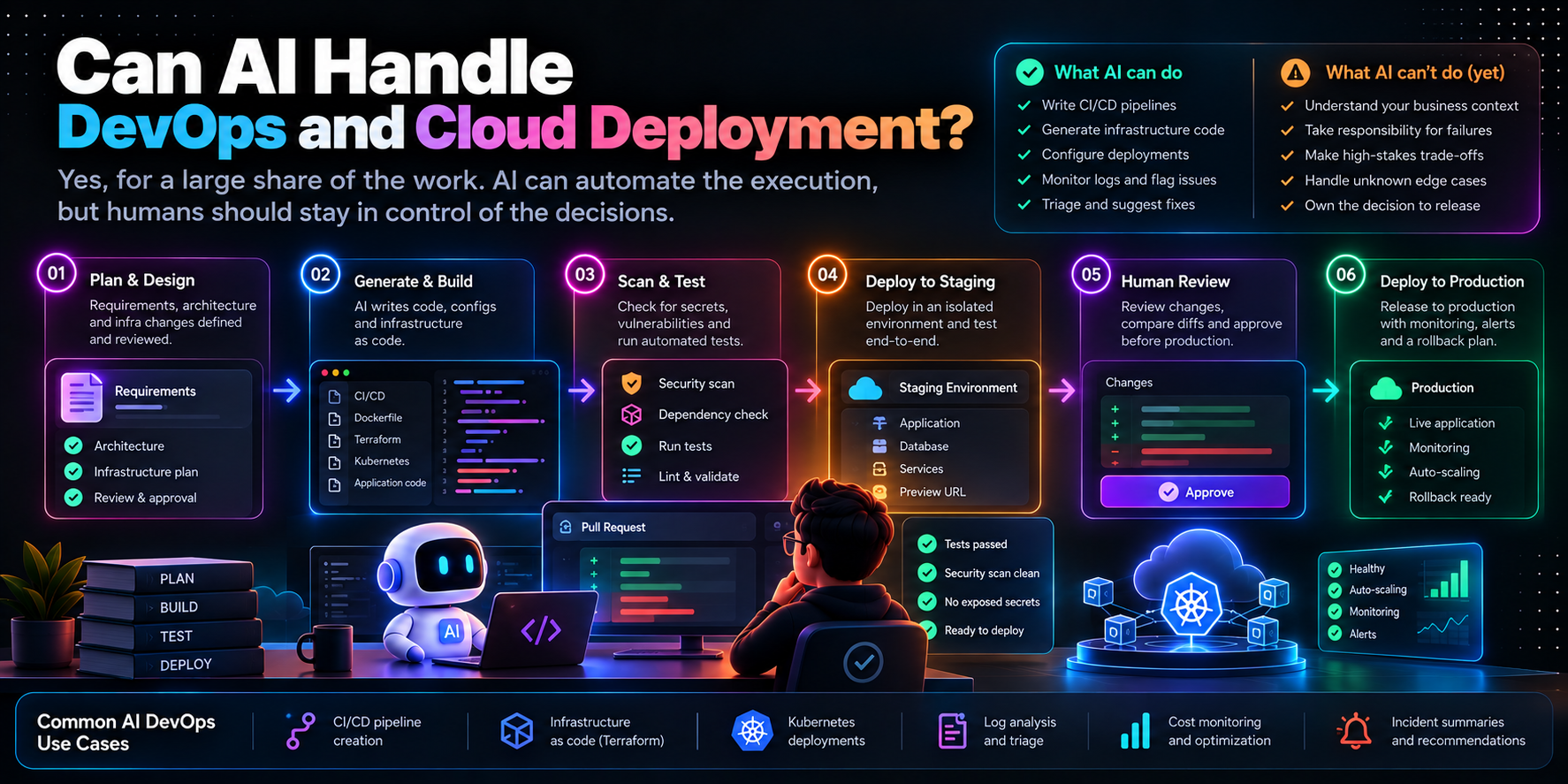
AI agents can now write CI/CD pipelines, generate infrastructure-as-code, configure Kubernetes deployments and summarize incidents. They are reliable at well-scoped, checkable tasks and unreliable at decisions that depend on business context or carry irreversible consequences. In practice, the setups that work let agents execute and propose, while people approve what reaches production.
This post walks through that boundary in detail: what is easy to hand over, what isn't, and how to structure a workflow so the handoff is safe.
What does it mean for an AI agent to handle DevOps?
DevOps is a chain: build, test, define infrastructure, deploy, scale, observe, respond. An agent can touch any link in that chain, but touching a link and owning it are different things.
Most real-world usage sits in the middle. The agent writes a change or proposes one, a person or an automated policy checks it, and the pipeline executes it. The agent is a fast, tireless contributor, not an unsupervised operator. That distinction is the whole discussion, so it is worth being precise about it before comparing capabilities.
Why is deployment the hard part of AI-assisted development?
Generating application code has become fast enough that the bottleneck moved. A working feature can exist in minutes, but a working feature is not a running service.
Between "it works" and "it's live" sit a lot of decisions that look small and aren't: how environments differ, where secrets live, what the network exposes, how the service scales, what happens when a deploy fails halfway. Each is a place where a plausible-looking configuration can be subtly wrong. For small teams without a dedicated platform engineer, that is where projects stall, and it is why the question of whether AI can handle this layer has become so common.
Which DevOps tasks can AI handle reliably today?
The reliable tasks share a property: the output can be inspected before it takes effect.
Pipeline and config generation. A workflow file, a Dockerfile, a Helm values file or a Terraform module is a structured artifact. An agent can draft it quickly, and you can read the diff, run a plan and lint it before anything is applied.
Review and scanning. Reading a pull request for risky changes, checking dependencies for known issues, and flagging hard-coded secrets or unauthenticated routes are pattern-recognition tasks that suit models well.
Triage and summarization. Correlating a failed deploy with the commit that likely caused it, reading logs across services and producing a readable incident summary saves real time during an outage.
Monitoring. Anomaly detection and cost flagging across more signals than a person can watch.
Usage data points the same way. In Pulumi's State of Agentic Infrastructure 2026, a survey of 510 platform, DevOps and product engineers, code review was the most common place teams used AI in their infrastructure workflow at 70%, while authoring infrastructure code was the least common listed use at 29%. Engineers appear to lean on AI to check and advise before they lean on it to author. Keep in mind Pulumi sells infrastructure tooling and the respondents skew toward mid-sized software companies, so treat the numbers as directional.
Where do AI agents still struggle in cloud deployment?
The failures cluster where the important context is not in the repository.
An agent does not know that a database must not restart during a nightly billing job, that an apparently unused volume holds data nobody documented, or that a customer contract forbids a region you were about to deploy to. It can't weigh cost against a reliability commitment, and it has no memory of the outage that explains why a setting looks strange. Multi-service failures, where the symptom is in one system and the cause is in another, remain difficult to diagnose without someone who understands how the pieces were built.
There is also the question of accountability. When a destructive change is applied, someone owns the outcome. That someone is a person, which is why autonomy tends to stop short of production.
The same survey reflects this. Among engineers who let agents change production infrastructure, 62% require approval, while 19% allow autonomous changes. At the same time, 63% say they trust agents to make production changes. Stated trust is running ahead of the guardrails teams actually use, and the useful engineering question is how to close that gap deliberately instead of by accident.
How should you structure an AI-assisted deployment workflow?
The workflow that tends to hold up has five properties.
A written plan comes first. Before an agent changes anything, requirements, architecture and the proposed change should exist as text a person can accept or reject. Every later change should arrive as a diff, not a surprise.
Work runs in isolation. Each task gets its own branch and workspace, so a mistake is contained and a failed attempt can be thrown away. Merging happens through a pull request, which also gives you the audit trail.
Automated checks gate the next step. Scan for leaked secrets, vulnerable dependencies and unprotected routes before a change can reach staging, and make open findings block promotion rather than merely warn.
Staging is the proving ground. AI-generated changes should deploy somewhere safe first, where behavior can be observed and compared against expectations.
Production is a deliberate act. Promotion is a decision, taken by a person, with a rollback path that has been tested rather than assumed. For infrastructure, this means a reviewed plan before apply, scoped credentials with least privilege, and progressive rollout patterns such as canary or blue/green where the risk justifies it.
None of this is exotic. It is ordinary release discipline applied to a contributor that is very fast and has no institutional memory.
What does this look like in an actual platform?
Some platforms are built directly around that structure. 8080.ai is one example: according to its site, it uses a nine-step process in which a requirements document, user flows and an architecture blueprint are approved before code is written, each task runs through a six-phase pipeline in an isolated cloud workspace and merges by pull request, and every task is scanned for secrets, vulnerable dependencies and unprotected API routes before it can reach staging. Finished work deploys to a per-project Kubernetes namespace, and promotion to production is something a person triggers.
You can also assemble comparable behavior yourself by combining a coding agent, infrastructure-as-code, CI policy checks and a manual approval step. The trade-off is control versus integration effort. Either way, the gates are the product, not the model.
Why are developers moving toward workflows with approval built in?
The motivation is less about speed than about being able to trust what is happening.
Engineers are not generally resistant to AI touching infrastructure. They are resistant to opaque changes. A tool that shows exactly what it intends to do and waits for approval feels qualitatively safer than one that acts first and reports afterward, even when the model is the same.
Assembly cost matters as well. Connecting an agent to CI, an IaC tool, a cluster, a scanner and an approval process means many integration seams, and each seam is a place where context gets dropped. A single flow from plan to deploy reduces that, which is the problem platforms like 8080.ai set out to address by keeping planning, scanning and deployment in one pipeline.
Finally, the shape of the work is changing. If review is already where AI is used most, then tools designed around review match the job better than tools designed around raw generation.
So, can AI handle DevOps and cloud deployment?
It can handle execution. Decisions that depend on context, trade-offs or accountability still need people.
A sensible way to adopt it is incrementally: begin in non-production environments, add approval gates where a mistake would be expensive, measure how often the agent's proposals are accepted unchanged, and widen its scope only as that evidence supports it. Done that way, AI removes the repetitive work from DevOps without removing the human judgment that keeps production stable.